Powered by Blogger.
RSS
Post Icon

Apple 'isn't reinventing the world' anymore


Apple's (AAPL) maverick image and marketing made it a hit with consumers and investors when smartphones were novel. But as boring replaces bold at the giant - investors need to reset their expectations, analysts say.
Fast-growth is being replaced with "annuity-like revenue streams" as Apple is "now mainstream and not the upstart," says UBS analyst Steven Milunovich in a note to clients Thursday. "Some might be disappointed that Apple isn't reinventing the world," he says. Milunovich expects 5% growth in iPhone unit sales in the current fiscal year. That's still a whopping number of smartphones being sold - 49 million in the current quarter - but on Wall Street single-digit growth just doesn't impress.
Investors and analysts are adjusting what they can expect from Apple - given the company is a behemoth and mathematically unlikely to put up the kind of growth that turned the stock into such a champ in the past. The same fate has met other high-growth companies that have matured as their products reached saturation and improvements have become incremental.
Meanwhile, Apple faces the additional challenge that carriers are moving away from subsidies, leaving consumers to see - often for the first time - what they're actually paying for upgraded phones. Sticker stock could cause some consumers to keep their existing "good enough" phones longer than two years.
And the iPhone 6S isn't a compelling upgrade - which changes the math at Apple. Even the iPhone 6 - which was seen as a big upgrade as the company finally matched the larger screen sizes of phones from Samsung and Microsoft (MSFT) - Apple's adjusted earnings grew 39%. That's a stellar growth rate - but still a fraction of the 54% adjusted profit growth in 2010 and 85% growth in 2011.
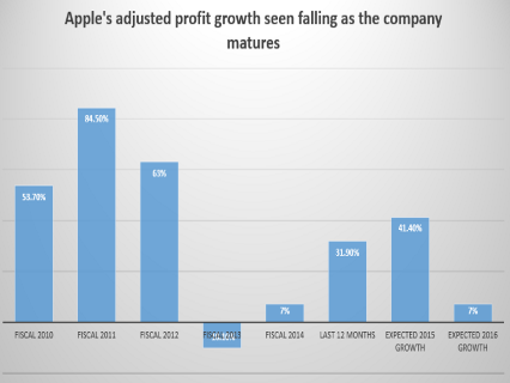
Reality is sinking in fast along with maturation. Analysts expect adjusted earnings growth to grow 32% in the current quarter - but then - drop off fast as the iPhone 6S fails to inspire the same level of upgrade fever. Adjusted profit growth is expected to be just 3.6% in the fourth calendar quarter and hit just 5.2% in the first quarter. Adjust profit growth is seen as being just 7% in fiscal 2016.
Meanwhile, the company has been widely called out on the fact it's newest product, the iPad Pro, is "aping Microsoft's Surface," Milunovich wrote. Microsoft released a tablet with a keyboard and stylus more than three years ago.
What's this mean for Apple stock? Most analysts remain bullish and think the stock could be worth close to $150 a share in 18 months. That would be 33% upside if correct. Shares of Apple closed up $2.42, or 2.2%, Thursday to $112.57. "Incrementalism not all bad," as the company can work on becoming more predictable and focus on selling more things to its loyal customers, Milunovich says .
But many investors may only be starting to appreciate how a maturing product can put a stock in neutral. Shares of Apple are down roughly 16% from the highs notched this year as investors confidence was soaring. "We remain cautious on Apple for the rest of the yer as we think the company has tough compares for iPhones, which could make it tough for the stock to work," says Abhey Lamba, analyst with Mizuho, who has a $125 price target on the stock.

  • Digg
  • Del.icio.us
  • StumbleUpon
  • Reddit
  • RSS
Post Icon

Investors shouldn't wait until Fed raises interest rates to take action


In the scheme of things, it might not matter. It might not matter whether the Fed raises interest rates this month or in the months to come.
What matters is what you need to do now with your money in anticipation of rates rising.
The stock market roller coaster. Stock market performance has historically been dramatically better in expansive monetary policy environments — when interest rates are falling and money is cheap to borrow — vs. restrictive ones,  according to Robert Johnson, president and CEO of The American College of Financial Services and co-author of Invest with the Fed: Maximizing Portfolio Performance by Following Federal Reserve Policy.
Now, that doesn’t necessarily mean that stocks are about to collapse as they did in 1987, when the Fed started to raise interest rates. But stock investors could be in for a bumpy ride. What to do? Stand pat, says Johnson, if you have a long-term horizon, and the stomach to handle the roller coaster ride that the equity markets may take us on in the near future. “If, however, a market fall of another 5 or 10% would cause (you) to panic and sell, then I would suggest (you) sell now,” he says.
 According to Johnson, the time to gauge your risk aversion is not when the markets are rising, but when they are under pressure. “Some investors simply don't have the mindset to weather volatility in the markets,” he says.  “The silver lining in this volatility may be that it will give investors the opportunity to get a feel for their true level of risk aversion.”
Shorten durations. When interest rates go up, bond prices go down. And the longer the maturity of the bond, the more prices go down.
So, in anticipation of the Fed raising rates — if only by one-quarter of 1% in September or later this year — now, if you haven’t done so already, would be the time to reduce your exposure to the long-end of the yield curve. “I believe that bond investors would be well-served to shorten the durations of their bond portfolios,” he says. Duration is a sophisticated way of looking at bond maturities. If you own bonds with long durations, you run the risk of selling at a loss.  “While the hike may not come in September — and it looks increasingly like it won't come in September — rates are going to rise and long-term bondholders are going to suffer a loss of purchasing power.” If, on the other hand, you plan to hold onto your bonds until maturity, there’s no need to sell bonds with long maturities and buy those with shorter ones.
Consider commodities. If past is prelude, consider investing in commodities — though not gold. “Now, over the next few years, I believe that an investor who buys commodities will earn returns that will exceed those in the bond market,” says Johnson.
Yes, this bet might take a bit of courage at the moment. “Commodities as an asset class are about as out of favor as an asset class can be,” says Johnson.
But your courage could be rewarded.  According to Johnson, a diversified basket of commodities represented by the Goldman Sachs Commodity Index (GSCI) returned a negative 0.19% when rates were falling and a robust 17.66% return when rates were rising. “As I expect rates to rise over the next few years, it would appear that investors should consider some allocation to commodities if the past is any indication of the future,” he says.

  • Digg
  • Del.icio.us
  • StumbleUpon
  • Reddit
  • RSS
Post Icon

Strategies: Small business depends on Silicon Valley


What’s Silicon Valley cooking up now to help small businesses?
I had a chance to find out when I arranged an “Insider’s Tour of Silicon Valley” to celebrate the 35th anniversary of America’s Small Business Development Center network (ASBDC).
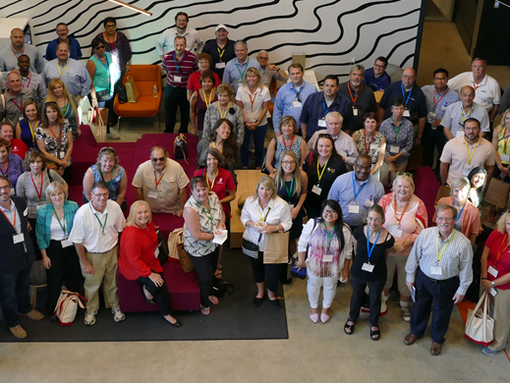
On Sept 9, I took approximately 70 small business consultants on a tour of three companies dramatically affecting the lives of small businesses: Google, Intuit and Facebook. My guests were ASBDC “State Stars” — individuals who made exceptional contributions to small business in their area.
For 35 years, SBDCs have helped small businesses, start-ups and the self-employed survive and thrive. Each year, more than 1 million entrepreneurs come through SBDC doors for free consulting or low-cost training. A new business is opened by an SBDC client every 33 minutes, a new job created every seven minutes.
For the first time, ASBDC held their annual conference in my hometown: San Francisco. That gave me a chance to give back to the SBDC network and show off my home — Silicon Valley — the epicenter of entrepreneurship.
I identified three companies dramatically transforming the way small companies do business.  All were generous, donating staff time, buses and food for the tour. These companies recognize the contribution SBDCs make to entrepreneurs in this country, creating jobs in big cities and small towns.
The day-long tour was incredibly fun and educational. The host companies shared insights about small business, even taking the occasion to announce new services.
• Facebook: A highlight of the day was when Chief Operating Officer Sheryl Sandberggreeted our group. Facebook took the opportunity of our presence to unveil new features of Facebook “Pages.” A “Page” is the term Facebook uses for a company’s Facebook presence, and more than 45 million businesses have Facebook Pages.
Facebook’s new Pages features make it easier for users to do business with a company through Facebook, especially on mobile devices. They’ve created a visible and customizable “call to action” button,  encouraging customers and prospects to contact you. Services or products can be clearly listed, and it’s easy to message a business, and far simpler for a company to respond quickly.
• Intuit: Our ASBDC group got to meet Intuit’s new head of small business, Karen Peacock. She and Al Ko, senior vice president, had a lively and positive discussion with the group about a range of Intuit’s small business offerings. SBDC consultants are already familiar with Intuit’s products, including QuickBooks, QuickBooks Payroll and Intuit Merchant Services, because a huge percentage of small businesses use Intuit products.
The transformative offering from Intuit is QuickBooks Online (QBO). QBO represents the beginning of a new ecosystem for small companies, where QuickBooks is the backbone carrying vital company information, enabling an untold number of third-party applications to add on to that backbone with specialized features, potentially making it possible for a small business to run virtually every aspect of their operations connected to QBO.

  • Digg
  • Del.icio.us
  • StumbleUpon
  • Reddit
  • RSS
Post Icon

Stocks take break from drama, climb a bit


After Wednesday's wild ride on Wall Street that ended on a down note, U.S. stocks rebounded a bit as investors braced for next week's Federal Reserve meeting on interest rates.
Most investors are still in wait-and-see mode ahead of the Fed's two-day meeting on Sept. 16-17 that could result in the first interest rate hike in almost a decade. Low rates, of course, have been cited as a key driver of the big stock market rally over the past 6 years.
The Dow Jones industrial average ended up 77 points, or 0.5%, after initially bouncing in and out of positive territory. Volatility continues to dominate the markets as the blue-chip index swung from a 172-point gain to a 239-point loss at the close Wednesday.
The Standard & Poor's 500 stock index gained up 0.5%, and the Nasdaq composite — which remains the only one of the three benchmarks in positive territory for 2015 — climbed 0.8%.
Investors remain uncertain as to what their next move should be, as there remains a lot of uncertainty as to whether the Fed opts to hike rates or hold off until later in the year. The Fed is dealing with crosscurrents, as the U.S. economy and labor market is gaining strength, which points to a coming hike. But on the flip side, market turbulence and financial instability due in part to China's slowing economy and weak stock market could give them pause.

  • Digg
  • Del.icio.us
  • StumbleUpon
  • Reddit
  • RSS
Post Icon

Brian Williams returns to air on MSNBC on Sept. 22 for pope visit


Brian Williams, the former NBC Nightly News anchor who was demoted for fibbing about his reporting experiences, will return to the airwaves on Sept. 22 in his new role as live breaking news anchor for MSNBC during the cable network's coverage ofPope Francis' visit to the U.S.
Williams doesn't have a dedicated time slot or program but will work on daytime programs as news breaks, NBC said.
In June, NBC News announced that Lester Holt, who had substituted for Williams as the anchor of NBC Nightly News while Williams was serving a six-month suspension, would become permanent anchor for the evening news program. It said then Williams would take a big pay cut and work on the breaking news desk at sister network MSNBC.
Williams, who had served as both chief anchor and managing editor of NBC Nightly News, was suspended in February after he was challenged on social media about a statement he made about his reporting tour in Iraq in 2003. Williams said he was on a helicopter that had been hit by enemy fire and forced down. Veterans from the convoy challenged Williams' story on Facebook. Williams eventually recanted the story on air after Stars and Stripes published a story about the online exchange.

  • Digg
  • Del.icio.us
  • StumbleUpon
  • Reddit
  • RSS
Post Icon

Cardinals played a center fielder who wasn't allowed to throw the ball


On Wednesday afternoon, in a big game against rival Chicago Cubs, St. Louis Cardinals manager Mike Matheny wanted a live bat in the lineup, so he asked Randal Grichuk to get in there.
The only problem? Grichuk had just returned from the DL with a strained right elbow. He could hit — just the day before he had knocked out a pinch-hit home run — but he couldn’t throw. Like, at all. He was not supposed to throw a baseball.
But the Cardinals needed him, so they put him in center field. He played center field without throwing a baseball. Whenever he got it, he’d hand it off to a teammate who would throw it in.
“We walked through every potential scenario that could possibly happen and told him exactly what his expectation is,” manager Mike Matheny said. “We told the other players too what the expectation is, and he understands. That was the only way this will work, and it’s the only way it’s an option. He gets it and … he’s concerned enough, too, to make sure he doesn’t do anything that sets himself back.”
“When teams see that, they’re going to run,” Heyward said.” I haven’t done that before. I don’t think I’ve seen it the whole time playing baseball — from five until now.”
The Cardinals won the game 4-3.
(Thanks to MLB for sharing.)

  • Digg
  • Del.icio.us
  • StumbleUpon
  • Reddit
  • RSS
Post Icon

Cowboys' Greg Hardy won't appeal four-game suspension


It seems Greg Hardy has already closely studied Tom Brady, who will officially be the first quarterback the Dallas Cowboys pass rusher pursues in 2015.
Hardy confirmed through a statement released by the NFL Players Association on Thursday that – unlike Brady – he won’t legally fight his four-game suspension, borne out of his domestic assault case while Hardy was a member of the Carolina Panthers last year.
“While I am terribly disappointed to miss the first four games of this season, I am absolutely determined that my issue is not going to be a distraction for the Cowboys,” Hardy said.
“I have enormous affection and respect for everyone here, and having seen the impact a court case can have on an NFL organization, I believe it is in the team’s best interest for me to announce that I will not pursue any further litigation.
“Everything I do from this point on will be designed to bring glory and pride to my family, their family and this team.”
Hardy’s original suspension under the NFL’s personal conduct policy was 10 games, but it was reduced to four by arbitrator Harold Henderson in July after he’d joined the Cowboys. Hardy will be eligible to play Oct. 11 when Dallas hosts Brady’s Patriots.
Hardy is expected to bolster a pass rush that also includes rookie Randy Gregory. Hardy collected 26 sacks for Carolina between the 2012 and 2013 seasons. He only played one game last year before going on the commissioner’s exempt list.

  • Digg
  • Del.icio.us
  • StumbleUpon
  • Reddit
  • RSS